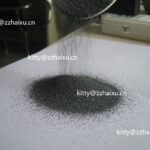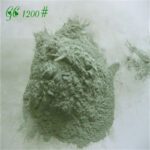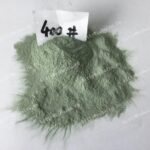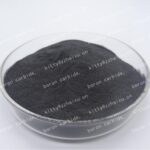

Why green silicon carbide micro powder can be used for grinding quartz sheets?
The Principle of Green Silicon Carbide Grinding Quartz Sheets
Quartz’s main component is silicon dioxide (SiO₂), with a Mohs hardness of approximately 7. Green silicon carbide micro powder(SiC) has a Mohs hardness of 9.2-9.4, significantly higher than quartz, making it a commonly used abrasive in quartz slicing, chamfering, grinding, and polishing processes.
1. Hardness Difference is the Basis of Grinding
Quartz: Mohs 7
green silicon carbide micro powder: Mohs 9.2~9.4
The abrasive’s hardness must be significantly higher than the workpiece to penetrate its surface and achieve micro-cutting and micro-fragmentation removal. If the abrasive’s hardness is lower than the workpiece, it will only slip and cannot grind.
White corundum has a Mohs hardness of 9, also higher than quartz, but green silicon carbide is more suitable for grinding quartz.
2. Crystal Characteristics: Sharp Corners, Good Brittleness (Self-Sharpening)
Green silicon carbide crystals are plate-like/multi-faceted, generating numerous sharp cutting edges upon breakage.
When grinding quartz sheets, the particles, under pressure, will micro-fracture along their cleavage planes, continuously generating new sharp cutting edges (self-sharpening), preventing them from quickly becoming rounded and dull.
Quartz is a brittle material, not a ductile metal, and its processing primarily relies on micro-fragmentation for removal. The brittleness of green silicon carbide is ideally suited for the “abrasive grinding” process used with brittle and hard materials.
Compared to white fused alumina: White fused alumina is more resilient and less prone to breakage, making it more suitable for metals; it tends to become dull and slippery when grinding quartz, resulting in lower removal efficiency compared to green silicon carbide.
3. Chemical stability, does not react with quartz.
Green silicon carbide micro powder is chemically inert at room temperature and does not undergo a solid-phase reaction with SiO₂ quartz. The grinding process does not create a modified layer or cause adhesion on the quartz surface, making it easy to clean after grinding and preventing surface contamination.